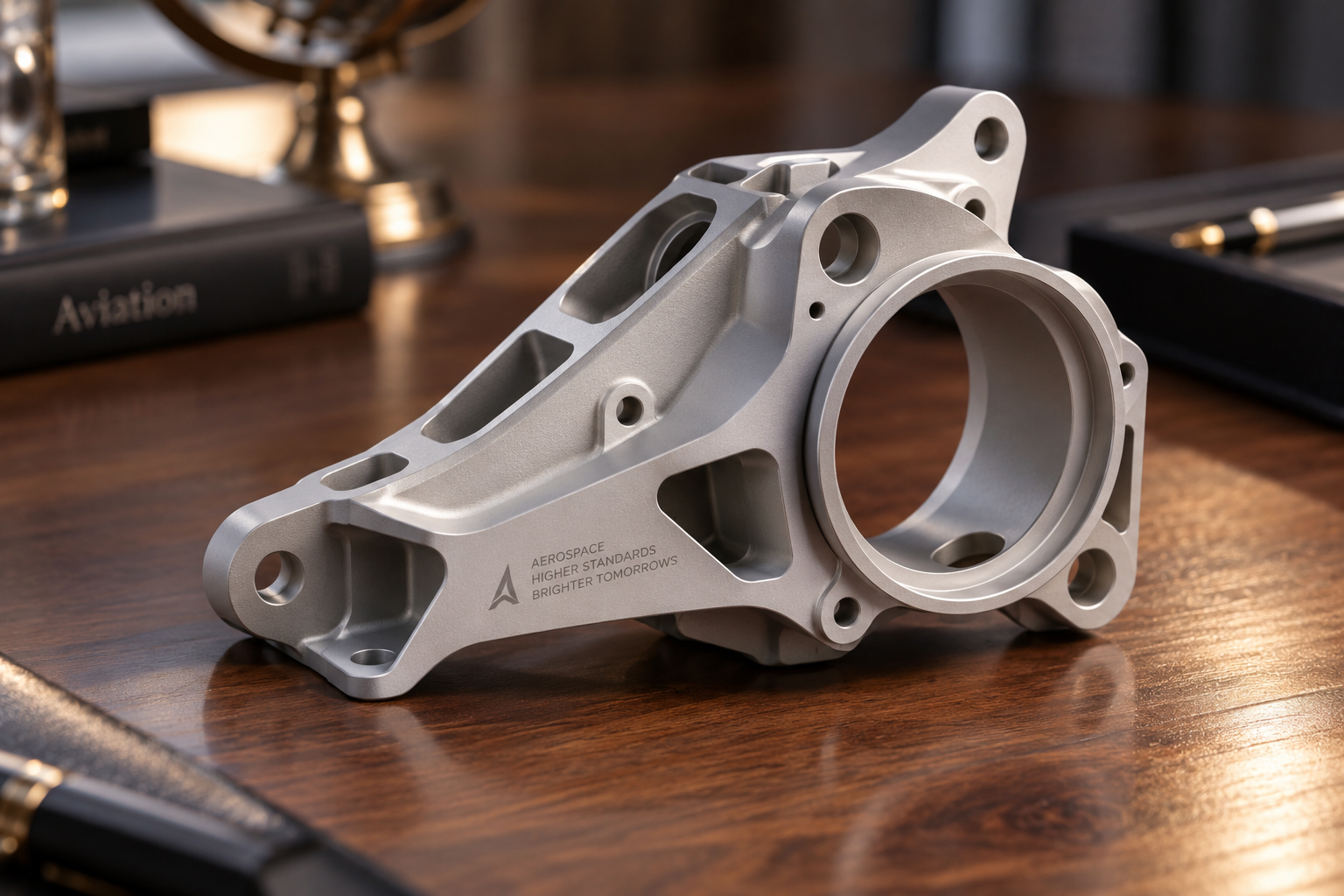
Powder coating is a dry finishing process used to apply a durable protective and decorative layer to metal parts. Instead of spraying liquid paint, finely ground powder is electrostatically charged, sprayed onto a grounded metal component, and then cured with heat to form a continuous coating.
For CNC machined parts, however, choosing powder coating involves more than selecting a color.
Coating thickness can change hole diameters and mating dimensions. Threads, bearing seats, electrical contacts, sealing surfaces, and precision bores may need to be masked. Deep pockets and sharp internal corners can also make uniform coating difficult.
For mechanical engineers, these details can determine whether a finished part assembles correctly or requires expensive rework.
This guide explains what powder coating is, how the powder coating process works, and—more importantly—how to specify it correctly for CNC machined metal parts.
How Does Powder Coating Work?
A typical powder coating process consists of surface preparation, masking, electrostatic spraying, curing, cooling, and final inspection.
1. Surface Preparation
A machined component should not normally go directly from the CNC machine to the powder coating booth.
CNC parts can contain cutting oil, coolant residue, fingerprints, oxide, dust, and other contaminants. If these remain on the surface, coating adhesion and appearance may be affected.
Depending on the material and application, preparation may include degreasing, cleaning, blasting, and chemical pretreatment.
For engineers, this means that machining quality alone does not guarantee coating quality. Surface preparation should be considered part of the finishing process.
2. Masking Critical Areas
Features that must remain coating-free are protected before spraying.
Common examples include threaded holes, precision bores, bearing seats, electrical grounding areas, sealing surfaces, and tight-tolerance mating features.
High-temperature tapes, plugs, caps, and other masking tools can be used depending on the geometry.
3. Electrostatic Powder Application
The powder particles receive an electrostatic charge as they leave the spray gun. Because the metal workpiece is grounded, the charged powder is attracted to its surface.
This makes it possible to coat complex metal components efficiently, although geometry still affects how evenly powder reaches every area.
4. Curing
After application, the coated part enters an oven. The powder melts, flows, and chemically forms a continuous coating.
There is no single curing temperature that applies to every powder. The required substrate temperature and curing time depend on the specific coating system. Powder manufacturers therefore provide cure schedules that should be followed for the selected product.
What Metals Can Be Powder Coated?
Powder coating is commonly used on electrically conductive metal components, making it well suited to many CNC machined parts.
Powder Coating Aluminum
Powder coating aluminum is common for machine housings, brackets, electronic enclosures, automation components, frames, and cosmetic CNC parts.
Grades such as 6061 and 6063 aluminum are frequently used in machined products that later receive a powder-coated finish.
Pretreatment is particularly important because the condition of the aluminum surface influences coating adhesion and corrosion performance.
Powder Coating Steel
Carbon steel and mild steel parts are also commonly powder coated. Typical applications include machine frames, mounting brackets, industrial housings, covers, and structural components.
Because steel can rust when exposed to moisture, the coating system and pretreatment should be selected according to the actual operating environment.
Powder Coating Stainless Steel
Stainless steel can also be powder coated when color, appearance, electrical insulation, or additional surface protection is required.
However, because stainless steel already provides corrosion resistance, engineers should first determine whether powder coating adds a functional benefit or is mainly being specified for appearance.
Types of Powder Coating
There are many powder formulations, but mechanical engineers usually do not need to become coating chemists. The important question is whether the selected powder matches the operating environment.
Epoxy powder coating can provide good adhesion and chemical resistance and is often used for indoor applications. However, many epoxy systems are less suitable for prolonged outdoor UV exposure.
Polyester powder coating is widely used for outdoor and industrial components because suitable formulations offer good weather and UV resistance.
Epoxy-polyester hybrid coatings are commonly used on indoor equipment where appearance, mechanical properties, and cost need to be balanced.
When specifying a coating, consider where the part will operate rather than choosing a powder only by color.
How Thick Is Powder Coating?
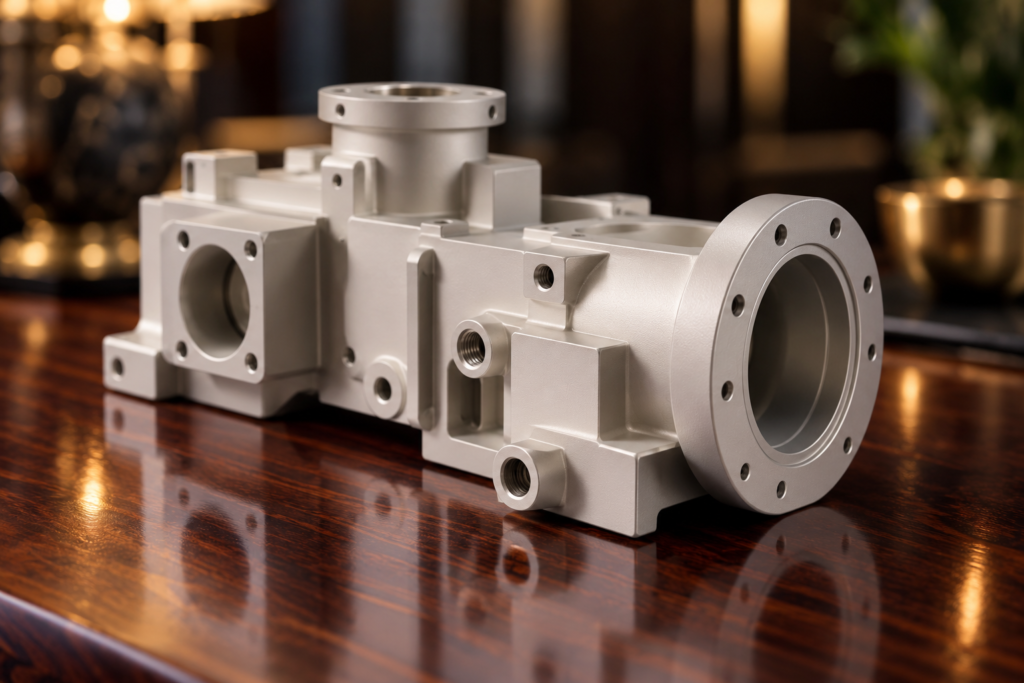
Powder coating thickness is one of the most important specifications for precision CNC parts.
The Powder Coating Institute defines film thickness as the depth of the cured coating and notes that it is commonly expressed in mils, where one mil equals 0.001 inch.
Actual thickness depends on the powder formulation, finish, geometry, application process, and performance requirements.
For example, some TIGER Drylac smooth powder coating systems recommend approximately 60–80 μm, while certain textured finishes may require approximately 90–120 μm. These numbers should not be treated as universal specifications; the product data sheet for the selected powder should control the final requirement.
This matters because powder coating creates measurable material buildup.
Consider a precision bore with a diameter of 10.00 mm.
If approximately 70 μm of coating reaches each side of the bore, a simplified calculation gives:
Diameter reduction ≈ 2 × coating thickness
2 × 0.07 mm = 0.14 mm
The theoretical finished opening could therefore be around 9.86 mm.
Actual buildup may not be perfectly uniform, so this calculation should be used to understand the risk—not to replace inspection.
For a cosmetic cover, 0.14 mm may not matter. For a bearing bore or locating hole, it can make the part unusable.
How Does Powder Coating Affect CNC Machining Tolerances?
This is where powder coating becomes a mechanical engineering issue rather than simply a cosmetic finish.
A CNC part can be completely within drawing tolerance after machining but fail assembly after coating.
Features that deserve special attention include precision bores, locating holes, press fits, threads, bearing seats, mating surfaces, datum surfaces, and sealing interfaces.
Instead of simply machining every feature oversized to compensate for powder, engineers should decide which surfaces actually need coating.
In many cases, critical functional surfaces are better protected with masking.
Another important detail is how dimensions are defined on the drawing.
If a dimension must be achieved after finishing, make that requirement explicit. For example:
Ø20.00 ±0.02 mm AFTER POWDER COATING
If a surface must remain uncoated, clearly identify it:
MASK THIS SURFACE — NO POWDER COATING
This removes ambiguity between the CNC supplier, finishing supplier, and inspection team.
What Areas Should Be Masked Before Powder Coating?
Masking is one of the easiest ways to prevent powder coating from creating assembly problems.
Typical masking areas include threaded holes, external threads, precision bores, bearing seats, press-fit surfaces, electrical contact areas, grounding points, sealing surfaces, and certain datum surfaces.
Hubs also notes that tapped holes, mating surfaces, and tight-tolerance features commonly require masking during powder coating.
Threads deserve particular attention.
If powder enters a small internal thread, the fastener may become difficult or impossible to install. Trying to force the screw can damage both the coating and the thread.
For production parts, it is much better to define the masking requirement on the drawing before manufacturing.
Design Guidelines for Powder-Coated CNC Parts
Good DFM can reduce powder coating defects, masking labor, and unnecessary rework.
One challenge is deep recesses and internal corners. Electrostatic fields can make it harder for powder to reach certain recessed areas uniformly. This behavior is commonly associated with the Faraday cage effect.
Part geometry should therefore provide reasonable spray-gun access whenever uniform coating inside a cavity is important.
Sharp edges can also be more difficult to cover consistently than broad, open surfaces. If the design allows it, reasonable edge radii can improve manufacturability.
Engineers should also think about how the component will be hung during coating.
The part needs electrical grounding and physical support. Wherever hooks or fixtures touch the component, complete coating coverage may not be possible.
For this reason, it can be useful to provide a hidden hole or non-cosmetic area that can be used for hanging. Hubs similarly recommends considering racking, grounding, hanging locations, and gun access during part design.
This small design decision can prevent a visible rack mark from appearing on a Class-A cosmetic surface.
Powder Coating vs Anodizing for CNC Aluminum Parts
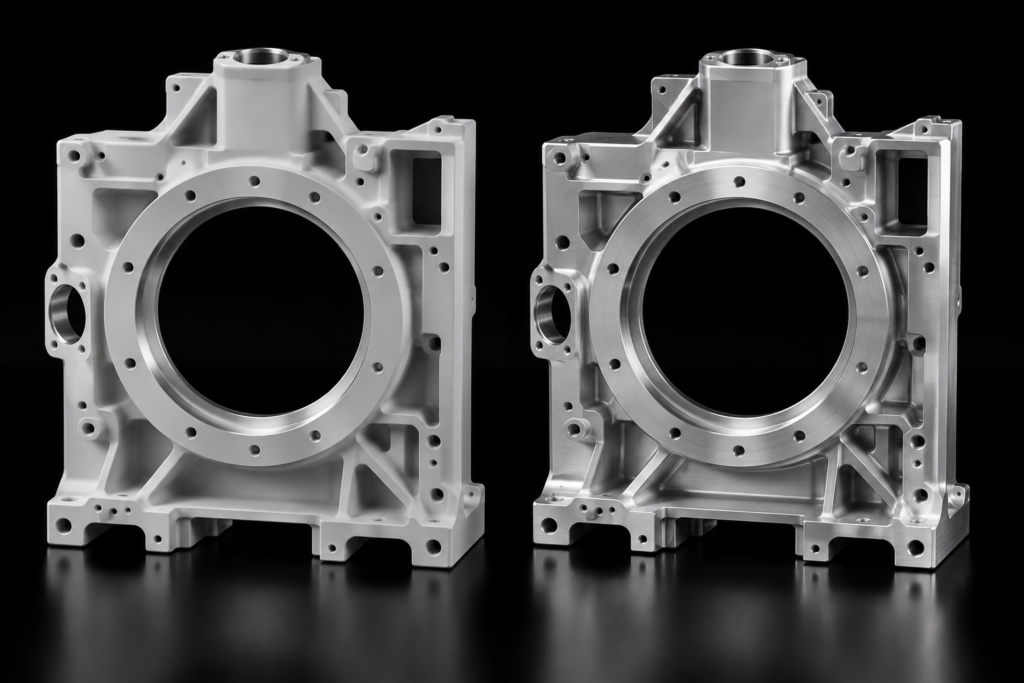
Powder coating and anodizing are both common finishes for aluminum CNC parts, but they behave differently.
| Engineering Factor | Powder Coating | Anodizing |
| Surface type | Polymer coating added to surface | Converts aluminum surface |
| Dimensional buildup | Relatively significant | Usually much lower |
| Color selection | Very wide | More limited |
| Surface appearance | Uniform, opaque | Can retain metallic appearance |
| Precision features | Often require masking | Usually easier to accommodate |
| Suitable materials | Aluminum, steel and others | Aluminum |
| Cosmetic coverage | Can hide minor visual variation | Substrate condition remains more visible |
One manufacturer comparison, for example, lists a typical 60–80 μm film for its polyester powder system versus a much thinner anodized layer depending on the anodizing application.
Powder coating is often attractive for machine housings, covers, external brackets, frames, and components requiring a broad range of colors.
Anodizing may be more suitable when maintaining the metallic character of aluminum or minimizing coating buildup is important.
The correct finish therefore depends on function, tolerance, environment, appearance, and cost—not simply which process is “better.”
Powder Coating vs Paint
Powder coating is frequently compared with liquid paint.
Powder coating generally provides a durable and consistent finish and is widely used for industrial metal components. It also offers many choices in color, gloss, and texture.
Liquid paint can be preferable in other situations, especially where very thin coating layers, large assemblies that cannot enter a curing oven, or specific repair requirements are involved.
For CNC components, however, the most important comparison is often not simply durability.
Engineers should ask:
How much dimensional buildup can the part tolerate?
A finish that performs well environmentally can still be the wrong choice if it prevents a precision assembly from fitting.
Common Powder Coating Defects and How to Prevent Them
Understanding common defects helps engineers distinguish between a coating-process problem and a part-design problem.
| Problem | Possible Cause | Engineering Action |
| Thread will not assemble | Powder entered thread | Specify masking |
| Bearing does not fit | Bearing bore was coated | Mask the bearing seat |
| Thin coating in deep recess | Geometry/electrostatic effect | Review geometry and gun access |
| Poor adhesion | Contamination or inadequate pretreatment | Review cleaning and pretreatment |
| Pinholes | Surface contamination or outgassing | Review substrate and process |
| Visible rack mark | Poor hanging-location planning | Define a non-cosmetic hanging area |
| Excessive orange peel | Film/application/cure issue | Review powder and process parameters |
Not every coating defect can be solved by changing the CAD model. But the earlier the finishing requirements are considered, the easier it is to separate design risks from process risks.
How Much Does Powder Coating Cost?
Powder coating cost is affected by much more than the physical size of the component.
For CNC parts, important cost drivers include part quantity, surface area, color, texture, masking complexity, pretreatment, hanging requirements, inspection requirements, coating specification, and whether the supplier must change powder colors between batches.
This is particularly important for small and medium-sized businesses ordering low-volume production.
A batch of 10 components may have a much higher finishing cost per part than a batch of 1,000 because cleaning, color setup, masking, racking, and process preparation still require labor.
Engineers can often reduce cost by standardizing colors, limiting unnecessary masking, designing convenient hanging locations, and clearly specifying cosmetic requirements.
How Should Powder-Coated CNC Parts Be Inspected?
Do not inspect a powder-coated CNC part only by checking whether the color looks correct.
Inspection should consider both the coating and the mechanical function of the component.
Important checks can include coating thickness, color and gloss, visual coverage, adhesion requirements, masked areas, threads, and critical dimensions after coating.
For assemblies, the most important inspection question is often simple:
Does the finished component still meet the functional drawing requirements?
Critical dimensions should therefore be inspected in their final condition when the drawing requires them after coating.
Powder Coating Checklist for Mechanical Engineers
Before releasing a powder-coated CNC part for quotation or production, confirm the coating type or performance requirement, color or RAL number, gloss or texture, cosmetic surfaces, masking areas, threaded features, bearing and locating bores, dimensions required after coating, electrical contact surfaces, acceptable rack-mark locations, and inspection requirements.
This information is much more useful to a CNC manufacturer than a drawing that simply says “black powder coat.”
Clear specifications allow the supplier to evaluate machining allowance, masking, coating access, dimensional risk, inspection, and cost before production begins.
Is Powder Coating Right for Your CNC Part?
Powder coating is an excellent option for many CNC machined metal components that require a durable, attractive, and repeatable finish.
The process is commonly used for machine enclosures, automation components, brackets, frames, electronic housings, covers, and other industrial parts.
The main engineering challenge is that powder coating is not dimensionless.
Its thickness must be considered whenever a component contains precision bores, threads, bearing seats, mating surfaces, press fits, sealing faces, or other tolerance-critical features.
The best results come when machining and finishing are considered together rather than treated as two unrelated manufacturing steps.
By defining coating requirements, masking areas, post-coating dimensions, cosmetic surfaces, and inspection criteria on the drawing, mechanical engineers can significantly reduce assembly problems and avoid unnecessary rework.
For custom CNC parts, involving the manufacturer before the design is finalized can also help identify coating risks early—when changes are still inexpensive.
Frequently Asked Questions
Can aluminum be powder coated?
Yes. Powder coating is widely used on aluminum CNC parts, including housings, brackets, frames, and machine components. Proper cleaning and pretreatment are important for reliable coating performance.
How thick is powder coating?
Thickness varies by product and finish. Some common smooth powder systems specify around 60–80 μm, while textured finishes can require greater film thickness. Always use the technical data sheet for the selected powder rather than assuming one universal value.
Does powder coating affect CNC tolerances?
Yes. Because powder coating adds material to the surface, it can change hole sizes, mating dimensions, threads, and fits. Critical areas should be masked or specified with final post-coating dimensional requirements.
Should threaded holes be masked before powder coating?
Usually, threads that need to function after finishing should be protected from unwanted coating buildup. Silicone plugs and other high-temperature masking methods are commonly used.
Can stainless steel be powder coated?
Yes. Stainless steel can be powder coated when color, appearance, insulation, or additional surface protection is required.
Powder coating or anodizing—which is better for CNC aluminum?
Neither process is universally better. Powder coating offers extensive color options and an opaque protective layer, while anodizing keeps more of the metallic character of aluminum and generally creates less dimensional buildup. The choice should be based on tolerances, environment, appearance, wear requirements, and cost.
Can precision CNC parts be powder coated?
Yes, but the finishing strategy should be planned before production. Precision holes, threads, bearing seats, sealing surfaces, and other functional features may require masking or post-coating inspection.