Introduction
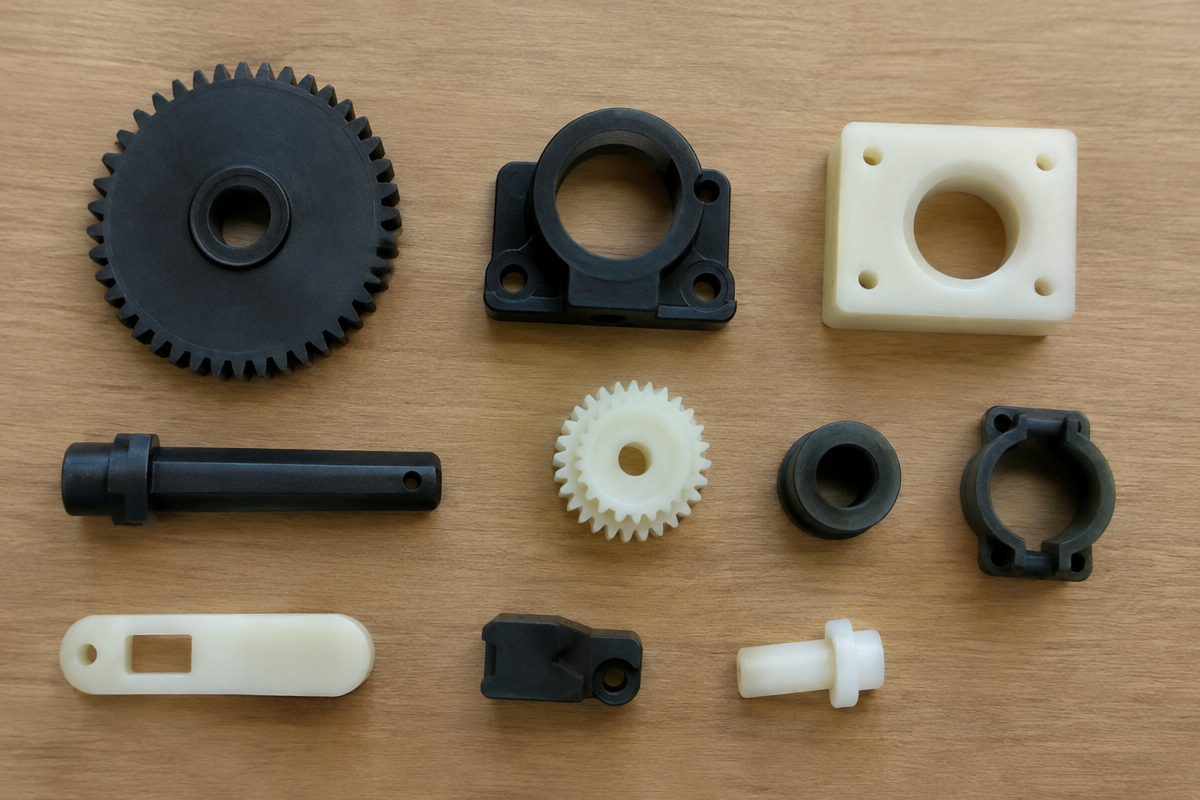
Nylon is widely used for CNC-machined components because it combines low weight, good wear resistance, useful mechanical strength, and low friction. It can replace metal in selected gears, bushings, rollers, guides, and insulating components. However, nylon does not behave exactly like metal: it absorbs moisture, expands or contracts as conditions change, and can deform under heat or clamping pressure. Choosing the right grade and accounting for these characteristics in the drawing and machining plan are essential for reliable parts.
1. What Is Nylon in CNC Machining?
Nylon, also called polyamide (PA), is an engineering thermoplastic that can be machined by CNC milling and turning. It is available in different grades, including PA6, PA66, and PA12. Each grade has a different balance of strength, stiffness, wear behavior, chemical resistance, moisture absorption, and dimensional stability.
Compared with many metals, nylon is lightweight, naturally electrically insulating, and can run with relatively low friction in suitable sliding applications. It is also useful for parts where noise reduction, corrosion resistance, or avoiding metal-to-metal contact matters. CNC machining is especially helpful when a component needs accurate bores, slots, threads, flat surfaces, or a custom geometry that must fit an existing assembly.
Nylon is not the best choice for every application. Its stiffness and temperature capability are generally lower than those of metals, and moisture can change its dimensions and mechanical properties. For high-load, high-temperature, or tightly toleranced components, engineers should evaluate the specific grade and the real service environment rather than selecting nylon by name alone.
2. PA6 vs. PA66 vs. PA12: Which Nylon Grade Is Best for CNC Machining?
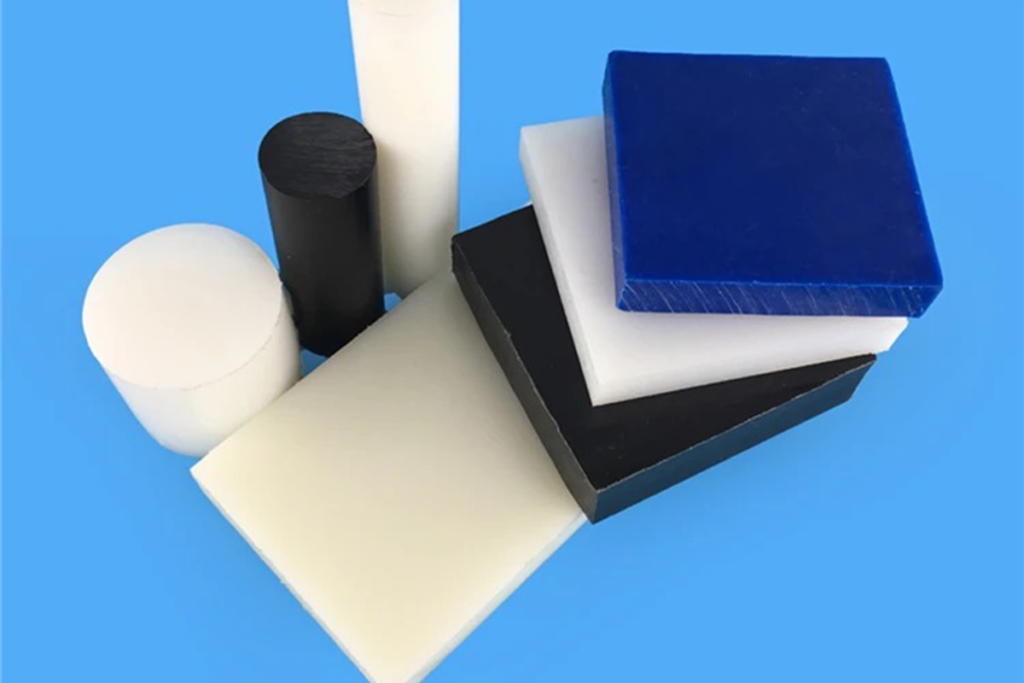
PA6, PA66, and PA12 are common options for machined nylon parts, but they are not interchangeable. The best choice depends on load, operating temperature, humidity, chemical exposure, required stability, and budget. The table below gives a practical qualitative comparison; exact performance varies by grade, supplier, reinforcement, conditioning, and test method.
| Property | PA6 | PA66 | PA12 |
| Mechanical strength | Good strength and toughness; often a balanced general-purpose choice | Generally higher stiffness and strength than standard PA6, especially at elevated temperatures | Usually lower stiffness than PA6/PA66, but tough and flexible |
| Wear resistance | Good; suitable for many sliding and wear parts | Good to very good; often selected for loaded mechanical parts | Good in suitable designs; performance depends strongly on grade and mating surface |
| Moisture absorption | Relatively high | Relatively high, often similar to or somewhat lower than PA6 depending on conditions | Low compared with PA6 and PA66 |
| Dimensional stability | Can change noticeably with humidity; allow for conditioning and swelling | Moisture-related dimensional changes can be significant | Generally better in humid or variable environments because it absorbs less moisture |
| Chemical resistance | Good against many oils and fuels; check specific chemicals and temperature | Good against many oils and fuels; check the exact medium and temperature | Good resistance to many oils, greases, fuels, and some chemicals; verify application compatibility |
| Machining characteristics | Machines well with sharp tools, but heat and clamping can cause distortion | Machines well; manage heat, stress, and moisture to maintain dimensions | Often attractive for precision parts where low moisture uptake is important; grade availability and cost may differ |
| Typical selection logic | General-purpose mechanical parts and cost-conscious designs | Parts needing higher stiffness or strength in suitable operating conditions | Parts needing lower moisture uptake and improved dimensional stability |
Practical selection tip: PA6 is a versatile starting point for general-purpose components, PA66 may suit applications that prioritize stiffness and strength, and PA12 is worth evaluating when moisture-related dimensional change is a major concern. These are broad guidelines, not a substitute for checking the technical data sheet of the exact material grade. Filled or modified grades can behave differently from unfilled nylon.
3. Common Applications of Nylon CNC Machined Parts
Nylon is used across industries where lightweight construction, wear resistance, electrical insulation, or reduced friction is useful. The correct grade should be selected based on the component’s load, speed, temperature, moisture exposure, and dimensional requirements.
| Industry | Typical CNC-machined nylon parts | Why nylon may be suitable |
| Industrial automation | Guide blocks, rollers, bushings, wear pads, custom fixtures | Low weight, wear resistance, and reduced friction in suitable sliding applications |
| Robotics | Spacers, cable guides, insulating mounts, selected gears and bushings | Helps reduce component weight and can limit metal-to-metal contact |
| Automotive | Bushings, clips, spacers, guide components, selected under-hood parts | Useful mechanical properties and resistance to many oils or automotive fluids, depending on grade |
| Electronics and electrical equipment | Insulating supports, standoffs, housings, mounting blocks | Electrical insulation and easy machining of custom shapes |
| Packaging and processing machinery | Wear strips, guide rails, rollers, change parts | Can reduce friction and surface marking when correctly designed |
| Industrial machinery | Bearing housings, sliding pads, protective blocks, custom spacers | Lightweight alternative for selected non-structural or moderate-load components |
These examples are starting points rather than universal recommendations. Nylon can absorb moisture and creep under sustained load, so components that carry continuous force, maintain critical alignment, or operate in hot and humid conditions need careful validation. For gears and moving parts, consider speed, lubrication, mating-material wear, noise, and heat generation as well as the nylon grade.
4. How Does Moisture Absorption Affect Nylon CNC Machining?
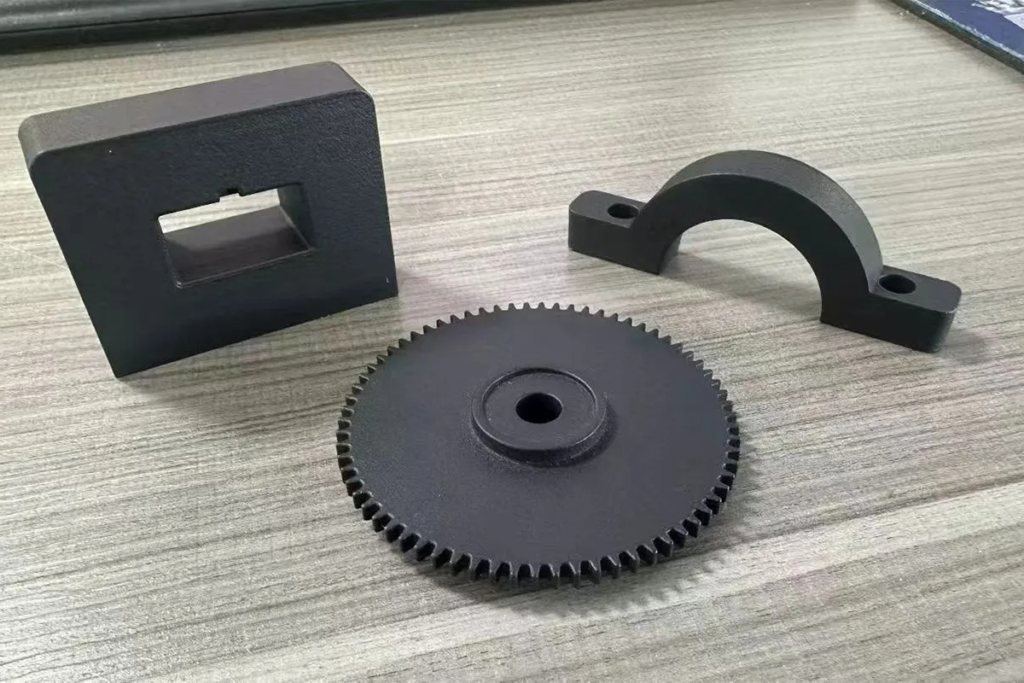
Nylon absorbs moisture from the surrounding air and may also take up water during use. As moisture content rises, the material can swell and its mechanical behavior can change. This can affect bore diameters, shaft fits, flatness, clearances, and the repeatability of precision assemblies. A component that measures correctly immediately after machining may not retain exactly the same dimensions after conditioning in a humid environment.
The amount of change depends on the nylon grade, initial moisture content, part geometry, ambient humidity, temperature, and time. PA6 and PA66 generally absorb more moisture than PA12, which is one reason PA12 is often considered for applications where dimensional changes caused by humidity need to be limited. Nevertheless, no nylon grade should be assumed to be completely dimensionally unaffected.
Engineers and buyers should identify the environment in which the part will be inspected and used. If the component will operate in humid conditions or must fit closely with metal parts, discuss material conditioning and inspection conditions with the supplier. Depending on the application, it may be appropriate to condition the stock or finished part before final inspection, establish a controlled measurement process, or specify functional clearances that account for expected dimensional change.
Moisture is only one source of dimensional variation. Cutting heat, residual stress, uneven stock removal, and excessive clamping force can also cause distortion. A reliable process manages both the material’s moisture condition and the machining strategy.
5. How to Achieve Dimensional Accuracy When CNC Machining Nylon
Achieving consistent dimensions in nylon requires more than using a precise CNC machine. Because nylon is relatively soft and sensitive to heat and clamping, the tool, cutting strategy, workholding, material condition, and inspection method all matter.
Use sharp tools and suitable cutting parameters
Sharp tools designed for plastics help produce clean cuts and reduce frictional heat. Cutting parameters should be selected for the specific grade, tool geometry, and machine setup. Excessive heat can soften the material locally, cause burrs, or contribute to dimensional variation. Tool paths should avoid unnecessary rubbing and allow chips to evacuate cleanly.
Control clamping and part support
Nylon can compress or deform when clamped too tightly. Use even, appropriate workholding and support thin walls or slender features where needed. If the part springs back after release, dimensions measured while it is clamped may not represent the finished condition.
Plan roughing and finishing operations
For demanding tolerances, remove material in stages rather than taking all material off in one aggressive pass. A roughing operation followed by a controlled finishing pass can help reduce the effects of residual stress and uneven material removal. Allow the part to stabilize when the design and process require it, then complete critical features in a consistent sequence.
Define the inspection condition
Inspection results are meaningful only when the measurement conditions are understood. For moisture-sensitive parts, record or control relevant conditioning and environmental conditions where necessary. Use suitable measuring tools and inspect critical features after the part has been released from the fixture. For tight fits, verify the functional assembly as well as individual dimensions when appropriate.
A tolerance such as ±0.01 mm should not be assumed achievable for every nylon feature or part geometry. Feasibility depends on size, shape, wall thickness, material grade, moisture condition, machining process, and inspection method. Identify critical dimensions on the drawing and ask the CNC supplier to review them before production.
6. What Should Mechanical Engineers Consider When Designing Nylon Parts?
Mechanical engineers can improve manufacturability and reduce rework by defining the service conditions and functional requirements before finalizing a nylon part drawing.
Choose the grade for the actual environment
Specify the intended nylon grade where requirements justify it, rather than writing only “nylon.” Consider load, impact, temperature, humidity, chemical exposure, wear, and electrical insulation. If dimensional stability in humid conditions is critical, compare PA12 with PA6 and PA66 using supplier data and application testing.
Account for moisture and fit
Decide whether dimensions must be met in a dry, conditioned, or service-equivalent state. For mating nylon-to-metal parts, consider potential moisture-related expansion and the expected operating environment when defining clearances, interference fits, and tolerances. Do not tighten every dimension unnecessarily; reserve the tightest tolerances for features that control function or assembly.
Design walls, holes, and threads for plastic
Avoid unnecessarily thin walls and fragile features that may deform during machining or service. Provide practical radii where possible and consider tool access for slots, pockets, and internal corners. For threaded features, assess engagement length, repeated assembly, and the risk of stripping; inserts or alternative fastening methods may be appropriate for some designs.
Consider creep, load, and heat
Nylon can deform gradually under sustained load, especially as temperature rises. Check whether the part must maintain alignment or preload over time. For moving components, consider frictional heat, lubrication, contact pressure, and the wear of both the nylon and its mating surface.
Make the drawing useful for manufacturing
Show critical dimensions, datums, geometric tolerances where needed, surface requirements, thread specifications, and any special inspection or conditioning requirements. Include the working temperature, humidity, chemical exposure, and load information when these affect material selection or performance. A drawing review with the CNC supplier can identify difficult tolerances, reduce unnecessary machining cost, and help prevent assembly issues.
Before ordering, buyers should confirm the exact material grade, whether it is filled or unfilled, applicable tolerances, inspection requirements, lead time, and any required material documentation. For critical applications, approve a prototype or first article under representative conditions before committing to repeat production.
Conclusion
Nylon can be an effective material for CNC-machined gears, bushings, guides, spacers, insulating supports, and other custom components. PA6 offers a versatile general-purpose option, PA66 can provide higher stiffness and strength in suitable conditions, and PA12 is especially worth considering when lower moisture absorption and dimensional stability are priorities. The best results come from matching the grade to the service environment, accounting for moisture and heat, using a suitable machining strategy, and clearly defining functional requirements on the drawing. Early communication between the engineer, buyer, and CNC supplier helps deliver parts that fit and perform reliably.