A Complete Guide to Processes, Materials, and Applications
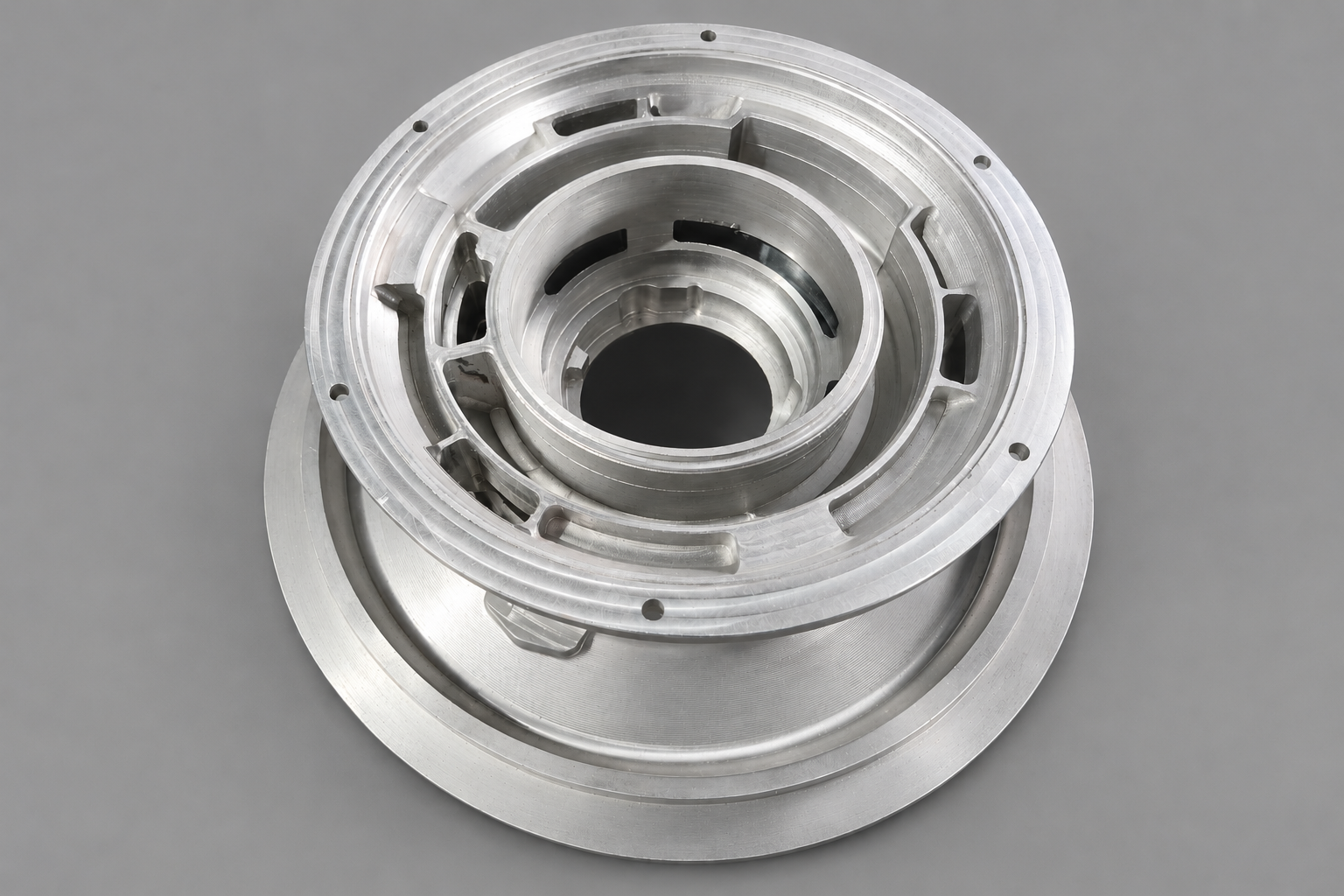
CNC machining is one of the most widely used manufacturing methods for producing precision components across industries. From automotive parts and industrial machinery to electronic housings and aerospace components, CNC machining helps manufacturers turn digital designs into accurate, functional parts.
But what exactly is CNC machining, how does it work, and when should you choose it for your project? Understanding the process, available materials, design requirements, and cost factors can help you make better manufacturing decisions.
In this guide, we will explain the basics of CNC machining, explore common machining processes and materials, discuss its advantages and limitations, and share practical tips for designing parts and choosing a reliable CNC machining supplier.
1. What Is CNC Machining and How Does It Work?
CNC machining stands for Computer Numerical Control machining. It is a manufacturing process that uses computer-controlled machine tools to remove material from a solid workpiece and create a part according to a digital design.
Unlike manual machining, where operators control many movements directly, CNC machines follow programmed instructions to control tool movement, cutting speed, feed rate, and other machining parameters. This makes it possible to manufacture complex components with consistent dimensions and repeatable results.
How Does the CNC Machining Process Work?
The typical CNC machining process involves several steps:
- Step 1: Create a CAD model. Engineers design the part using computer-aided design (CAD) software. The model defines the geometry, dimensions, holes, threads, and other features.
- Step 2: Generate a machining program. Computer-aided manufacturing (CAM) software converts the design into toolpaths and generates instructions that the CNC machine can execute.
- Step 3: Prepare the machine and material. The operator selects the appropriate raw material, cutting tools, workholding method, and machine settings.
- Step 4: Machine the part. The CNC machine follows the programmed toolpaths to remove material through milling, turning, drilling, or other operations.
- Step 5: Inspect and finish the part. After machining, the component may undergo deburring, dimensional inspection, surface finishing, or additional processing.
The exact workflow depends on the part’s geometry, material, tolerances, and production requirements. For complex components, multiple setups or machining operations may be necessary.
2. What Are the Different Types of CNC Machining Processes?
Different CNC machining processes are suited to different part geometries. Selecting the right process can improve accuracy, reduce production time, and control manufacturing costs.
CNC Milling
CNC milling uses rotating cutting tools to remove material from a stationary or securely positioned workpiece. It is suitable for producing flat surfaces, slots, pockets, holes, contours, and complex three-dimensional features. Common applications include mounting brackets, machine housings, heat sinks, and custom mechanical components.
Three-axis milling is suitable for many standard parts. Four-axis and five-axis machines can access additional surfaces and complex angles, potentially reducing the number of setups required.
CNC Turning
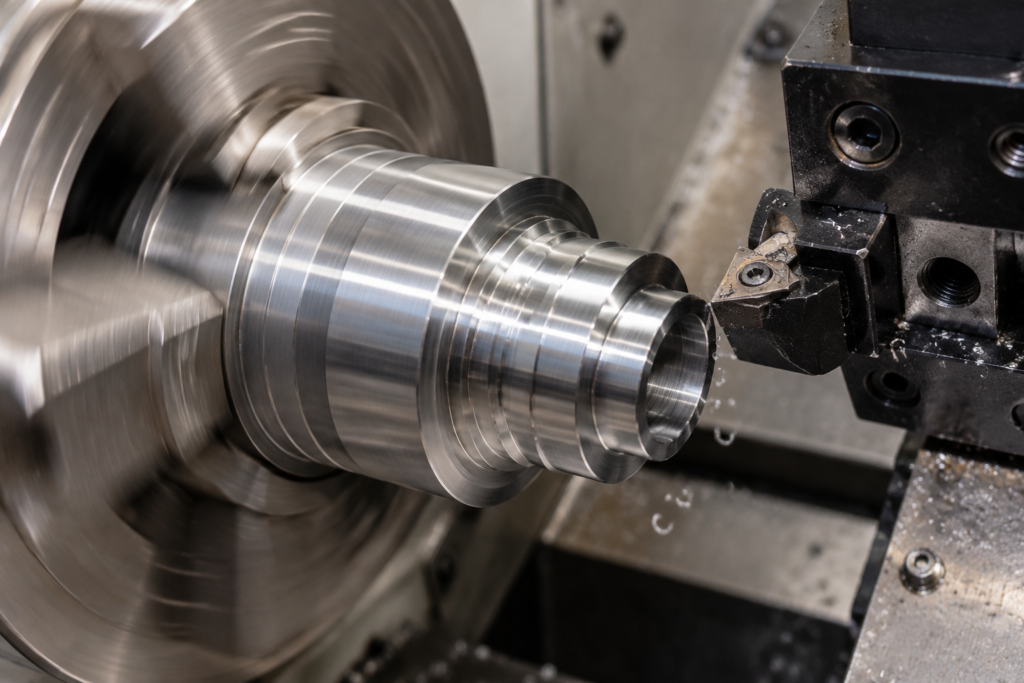
CNC turning rotates the workpiece while a cutting tool removes material. It is particularly effective for manufacturing cylindrical or rotationally symmetrical components. Typical examples include shafts, pins, bushings, threaded components, and precision fittings.
For parts that combine rotational features with milled surfaces, mill-turn machining can perform multiple operations on one machine, reducing handling and setup requirements.
Other CNC Machining Operations
CNC drilling produces holes in specified positions and dimensions. Other specialized operations may include boring, reaming, tapping, and precision contour machining. The best process depends on the part’s shape, material, required accuracy, and production volume. For example, a cylindrical shaft may be produced primarily through turning, while a complex bracket with pockets and mounting holes may require milling and drilling.
3. What Materials Can Be Used in CNC Machining?
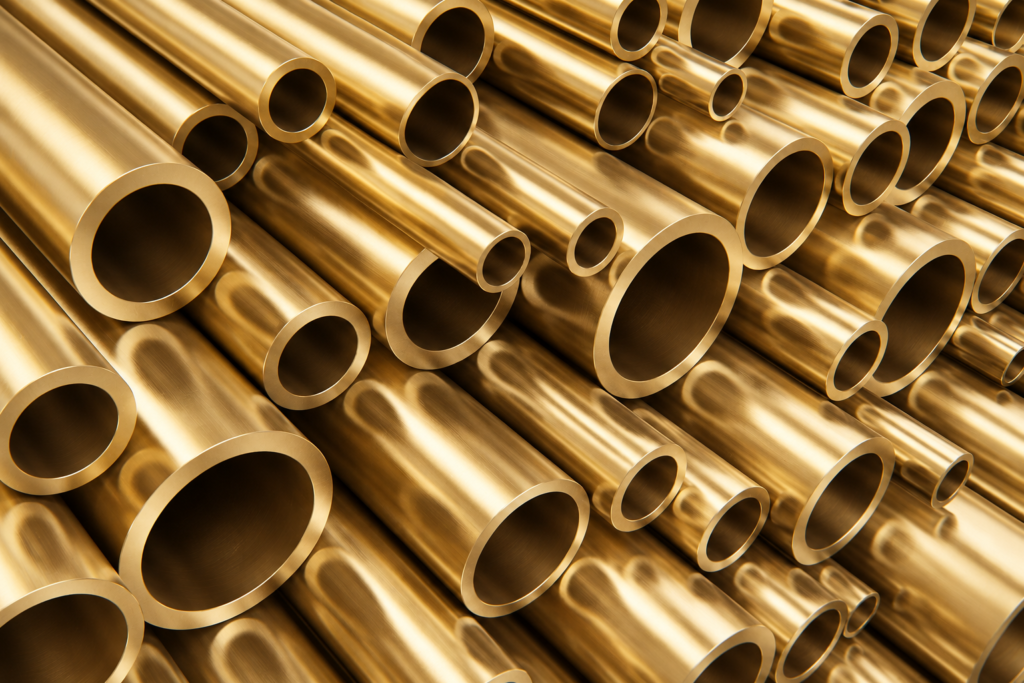
Material selection directly affects a component’s strength, weight, corrosion resistance, machinability, and overall cost. The best CNC machining material is not necessarily the strongest or most expensive option. It is the material that meets the application’s requirements without unnecessary expense.
Aluminum
Aluminum is popular for CNC machining because it is lightweight, relatively easy to machine, and offers good corrosion resistance in many environments. Aluminum 6061 is widely used for brackets, housings, fixtures, and general-purpose components. Aluminum 7075 provides higher strength and is often considered for demanding structural applications, although its corrosion behavior and cost should be evaluated for the intended environment.
Stainless Steel
Stainless steel is commonly selected for applications requiring corrosion resistance, durability, or mechanical strength. Stainless steel 304 is suitable for many general-purpose components, while 316 is often preferred for environments with greater exposure to corrosive agents, including chlorides. Both grades require appropriate consideration of machining conditions and the final operating environment. Typical applications include fittings, equipment components, brackets, and industrial hardware.
Carbon Steel, Brass, Copper, and Titanium
Carbon steel is frequently used for mechanical components that require strength and durability. The appropriate grade depends on the required mechanical properties, heat treatment, and operating conditions. Brass offers good machinability and is commonly used for fittings, connectors, and precision hardware. Copper is useful when electrical or thermal conductivity is important, although its machining behavior differs from brass.
Titanium offers a high strength-to-weight ratio and excellent corrosion resistance in many environments. However, it can be more challenging and expensive to machine than common aluminum alloys.
Engineering Plastics
CNC machining can also produce parts from engineering plastics, including:
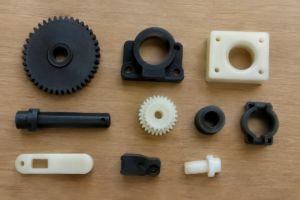
- POM (acetal or Delrin): Suitable for gears, bushings, and sliding components that require dimensional stability and low friction.
- Nylon: Used for wear-resistant components, spacers, and certain mechanical parts.
- PEEK: Selected for demanding applications requiring high temperature resistance and strong mechanical performance.
- ABS: Often used for housings, prototypes, and general-purpose components.
When choosing a plastic, consider moisture absorption, thermal expansion, chemical exposure, and the loads the part must withstand.
4. What Are the Advantages and Limitations of CNC Machining?
Key Advantages
- High precision and repeatability. Properly configured CNC machines can produce parts within specified dimensional tolerances and repeat the process across production batches.
- Wide material selection. CNC machining supports many metals and engineering plastics, allowing engineers to select materials based on actual performance requirements.
- Design flexibility. Milling and turning can produce a broad range of geometries, including pockets, holes, threads, curved surfaces, and complex mechanical features.
- Suitable for prototypes and production. CNC machining is useful for one-off prototypes, engineering validation, low-volume production, and many ongoing manufacturing applications.
- No dedicated production mold required. Unlike injection molding, CNC machining generally does not require a custom mold, which can make it attractive for early development and smaller production runs.
Important Limitations
CNC machining removes material from a workpiece, so some material becomes chips or scrap. Deep cavities, thin walls, difficult-to-access features, and tight tolerances can increase machining time and cost. Specialized materials may require slower cutting speeds, dedicated tooling, or additional inspection. Complex parts can also require multiple setups.
For very large production volumes of suitable plastic parts, injection molding may offer a lower per-part cost after the mold investment is recovered. For certain lightweight geometries, additive manufacturing may provide design advantages. The right manufacturing method depends on the component’s geometry, material, performance requirements, production quantity, and total project cost.
5. What Are the Common Applications of CNC Machining?
CNC machining is used in industries where components must meet specific dimensional, mechanical, and functional requirements.
Automotive and Aerospace
Automotive applications include brackets, shafts, housings, mounting components, and prototype parts. Aerospace applications may include lightweight structural components and precision hardware made from approved materials. These industries often require careful control of dimensions, materials, and inspection procedures. Specific requirements depend on the component and applicable industry standards.
Robotics and Industrial Machinery
Robotics and automation systems use CNC-machined brackets, grippers, mounting plates, shafts, fixtures, and custom housings. Accurate interfaces and consistent dimensions help components fit together and operate as intended. CNC machining is especially useful when designs need to be customized for particular machines or production systems.
Medical Equipment and Electronics
CNC machining can produce instrument components, equipment housings, connector bodies, heat sinks, and precision mechanical parts. For medical applications, the material, cleanliness, traceability, validation, and regulatory requirements must be appropriate for the intended use. Not every CNC-machined component is suitable for direct medical or implantable applications.
Custom Mechanical Components
Many businesses use CNC machining to manufacture custom parts that are difficult to source as standard products, such as:
- Shafts, bushings, and precision pins
- Aluminum enclosures and mounting brackets
- Hydraulic and pneumatic fittings
- Machine fixtures and tooling components
- Custom gears and mechanical housings
For these applications, CNC machining offers flexibility when a part must match a specific design rather than an off-the-shelf specification.
6. How to Design Parts for CNC Machining
A part that is easy to manufacture is often less expensive and more consistent than one with unnecessary complexity. Design for manufacturability (DFM) helps engineers account for machining limitations before production begins.
Consider Wall Thickness and Internal Corners
Very thin walls may vibrate, deform, or become difficult to machine, depending on the material, geometry, and part size. Designers should evaluate whether each wall needs to be as thin as originally specified. Internal corners also require attention because milling tools have a finite radius. Adding suitable internal corner radii can make machining easier and reduce the need for smaller cutting tools.
Specify Practical Tolerances
Tolerances define the acceptable variation in a part’s dimensions. Tighter tolerances generally require more careful machining, measurement, and process control. Avoid applying extremely tight tolerances to every feature. Instead, identify the dimensions that affect fit, movement, sealing, alignment, or other critical functions. This approach helps balance product performance and manufacturing cost.
Define Surface Finish Requirements
Surface finish affects appearance, friction, sealing, wear, and sometimes corrosion performance. Specify the required finish only where it matters. For example, a mating surface may need a controlled finish, while a nonfunctional exterior surface may not require the same level of refinement. If anodizing, plating, or another surface treatment is required, discuss dimensional allowances and post-processing requirements with the manufacturer before production.
Reduce Unnecessary Complexity
Whenever possible, simplify deep pockets, difficult-to-reach features, excessive tool changes, and unnecessary setups. For a manufacturability review, provide a 3D CAD model and a technical drawing that identifies critical dimensions, tolerances, material specifications, and finishing requirements. A supplier can then assess potential manufacturing challenges before quoting the job.
7. How Much Does CNC Machining Cost and How Do You Get a Quote?
CNC machining costs vary significantly depending on the component and manufacturing requirements. There is no single price that applies to all CNC-machined parts.
Factors That Affect CNC Machining Costs
- Material selection: Raw material prices vary by alloy, grade, availability, and stock size. Difficult-to-machine materials may also increase tooling and machining costs.
- Part complexity: Deep cavities, complex contours, thin walls, and difficult tool access can increase programming and machining time.
- Tolerance requirements: Tight tolerances may require additional process control, inspection, and finishing operations.
- Production quantity: Prototypes often have higher costs per part because setup and programming expenses are spread across fewer units. Larger quantities can reduce unit costs when the production process is suitable.
- Surface finishing and inspection: Anodizing, polishing, plating, special packaging, material certification, and additional inspection can affect the final quote.
CNC Machining vs. Other Manufacturing Methods
CNC machining is often a practical option for prototypes, custom components, and low- to medium-volume production. It can also be suitable for larger production runs when the geometry, material, and economics support it. Injection molding may become more economical for high-volume production of suitable plastic components, while 3D printing can be useful for complex geometries and certain rapid-prototyping applications. Compare the total cost of producing acceptable parts rather than looking only at the initial unit price.
What Do You Need for a CNC Machining Quote?
To receive an accurate quote, prepare the following information:
- CAD files: A 3D model in STEP format is commonly useful.
- Technical drawings: Include critical dimensions, tolerances, threads, and other requirements not fully defined by the model.
- Material specification: Identify the required alloy or plastic grade.
- Surface finish: Specify anodizing, passivation, plating, or other required treatments.
- Quantity: Provide prototype quantities, initial order quantities, and expected future demand when available.
- Delivery requirements: Include your target schedule and shipping destination.
When comparing suppliers, evaluate manufacturing capabilities, communication, inspection procedures, material traceability where required, delivery reliability, and the clarity of their quotations—not just the lowest price.
Frequently Asked Questions About CNC Machining
Is CNC machining suitable for prototypes?
Yes. CNC machining is widely used for functional prototypes because it can produce parts from production-relevant materials without requiring a dedicated injection mold.
What tolerances can CNC machining achieve?
Achievable tolerances depend on the machine, material, geometry, part size, machining process, and inspection method. General machining tolerances and tighter precision requirements should be discussed with the supplier before production. Do not assume every feature can achieve the same tolerance economically.
Is CNC machining expensive?
The cost depends on material, complexity, machining time, quantity, finishing, and inspection. Simplifying the design, avoiding unnecessary tight tolerances, and selecting an appropriate material can help reduce costs.
Which file format should I send to a CNC machining manufacturer?
STEP is commonly used for 3D CAD models. A dimensioned engineering drawing is also valuable when specific tolerances, threads, surface finishes, or inspection requirements must be communicated.
Conclusion
CNC machining is a versatile manufacturing method for producing precision parts from metals and engineering plastics. By understanding the available processes, selecting materials based on functional requirements, and designing parts for manufacturability, businesses can improve part quality while controlling production costs.
Whether you need a single prototype, a small batch of custom components, or ongoing production, choosing the right manufacturing process and supplier is an important part of achieving consistent results.
Looking for custom CNC machining services? Prepare your CAD files, technical drawings, material specifications, and quantity requirements. A qualified CNC machining supplier can review your design, identify potential manufacturing improvements, and provide a quote based on your project’s actual needs.